
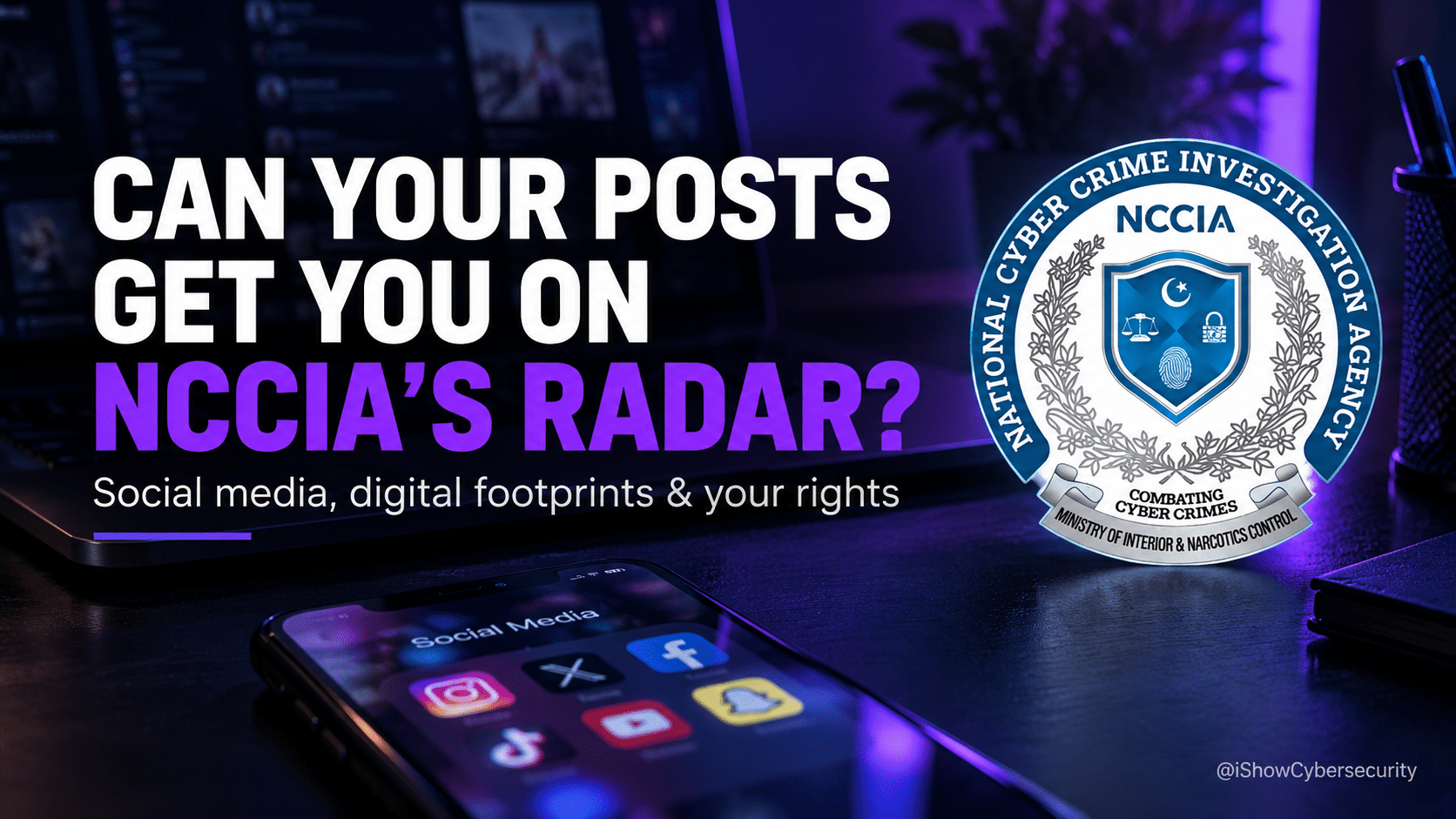
NCCIA social media monitoring is back in the news. A comment, a repost or a DM usually feels harmless. But sometimes what you post, share or send ends up mattering in a cybercrime case.
On October 28, 2026, Daily Ausaf reported that Pakistan’s National Cyber Crime Investigation Agency (NCCIA) is focusing on three areas: content it considers anti-state, online harassment, and illegal call centres. The report also warned about scams aimed at social media users.
So what does this mean for an ordinary user? Here is the plain version, without panic and without exaggeration.
What NCCIA social media monitoring covers
NCCIA investigates cybercrime under Pakistan’s Prevention of Electronic Crimes Act (PECA). That includes online fraud, harassment, identity misuse and similar offences. People can also report cybercrime to it.
Social media can become part of an investigation. Public posts, account records and login data may all be looked at. But a digital trace is not proof of a crime on its own. The evidence still has to fit the law.
1. Sharing false or misleading content
PECA was amended in January 2025. The new Section 26A covers people who intentionally share information that they know, or have reason to believe, is false, and that is likely to cause fear, panic, disorder or unrest. The maximum punishment is three years in prison, a fine of up to Rs2 million, or both.
A few things to keep in mind:
- The law talks about intent and knowledge. Sharing something you honestly believed was true is not the same as spreading something you knew was fake.
- Disagreeing with a policy or criticising a public issue is not automatically a crime.
- The amendment is disputed. Journalist unions and rights groups say its wording is vague, while the government says it is needed to fight disinformation. In practice, be careful with claims you can’t back up.
Before you share something:
- Check where it came from.
- Find the original statement or document, not just a screenshot of it.
- Be wary of dramatic claims with no proof.
- If you shared something false, take it down or correct it. If a dispute has already started, save a copy of what you posted first.
2. Harassment, blackmail and impersonation
Social media is also used to threaten and scare people. Examples of what can lead to a complaint:
- Threatening someone in messages or comments.
- Making a fake account in another person’s name.
- Using private photos or information to blackmail someone.
- Sharing intimate images without consent.
- Repeatedly sending abusive or threatening messages.
The harm to victims is real: anxiety, damaged reputation, money problems and fear for their safety.
If someone is harassing you:
- Don’t delete everything, and don’t reply with threats.
- Save screenshots, profile links, dates and the original messages. Don’t edit them.
- Secure your accounts: change passwords, log out of unknown sessions, turn on two-factor authentication.
- If they threaten to leak private material, get legal advice and report it through an official channel.
You don’t have to deal with serious abuse alone.
3. Scams and illegal call centres
Not every case starts with a post. Some start with a page or account built to take your money or personal details. Common ones are fake investment schemes, fake online shops, impersonation accounts, fake ads, and messages saying you won a prize or must verify your account right now.
Scammers push urgency. They promise guaranteed returns, press you to pay quickly, or ask for your OTP. Illegal call centres can be part of organised fraud that targets people through calls and online messages.
Four ways to protect yourself:
- Never share your OTP or banking PIN. No genuine person needs it in a chat or on a call.
- Verify before you pay. Check the seller or investment company independently. A social media profile is not proof.
- Treat “guaranteed profit” as a warning sign. Risk-free returns don’t exist.
- Act fast if you’ve been scammed. Call your bank or payment provider right away and save the transaction details and chats.
Can investigators trace your activity?
In an NCCIA social media investigation, they can look at public posts, account details, login records, IP addresses and other evidence they can lawfully get.
But an IP address alone doesn’t point to one person. Shared internet, public Wi-Fi, a VPN or a hacked device can all muddy it. Investigators have to weigh all the evidence, not one technical clue.
Also, deleting a post doesn’t make it vanish. Someone may have a screenshot, and platforms may keep their own records.
The takeaway isn’t to be paranoid. It’s to remember that online activity leaves a trail.
What if NCCIA contacts you?
A call, notice or request for information doesn’t mean you committed an offence. If you get one:
- Confirm who is contacting you using official contact details you find yourself, not the ones they give you.
- Read any notice carefully and keep a copy.
- Never give passwords, OTPs or bank details to an unverified caller.
- If you’re asked for an interview or a statement, talk to a lawyer first.
Don’t ignore a genuine legal notice because you think it’s a mistake. And don’t trust a message demanding money or personal data just because it says it comes from an agency.
Simple habits that keep you safer
- Check before you repost. Source first, share second.
- Lock down your accounts. Use unique passwords and two-factor authentication. See our guide: [LINK TO YOUR POST].
- Respect privacy. Don’t share other people’s photos, details or chats without permission.
- Keep records. For threats, blackmail or fraud, save the evidence instead of arguing online.
- Know where to report. Start with the official NCCIA website.
The bottom line
You don’t need to quit social media. Most people will never face an NCCIA social media case. But the rules are real, and a careless repost or a rushed reply can cause trouble.
Verify what you share, treat others with respect, secure your accounts, and remember that an allegation is not the same as proof. If you think an authority has treated you unfairly, document it and use the right legal or administrative channel.
Have you ever come across a fake account or a scam and not known where to report it? Tell us in the comments.
Follow @iShowCybersecurity for more practical tips on cybersecurity, privacy and staying safe online.
This article is for general awareness and is not legal advice. Laws and procedures can change, so check current official sources or talk to a qualified lawyer about your situation.
Sources
- Daily Ausaf: 3 Social Media Activities That Can Put You Under NCCIA’s Radar
- NCCIA official website and FAQs
- Official NCCIA complaint portal
- Pakistan Citizen’s Portal
- Prevention of Electronic Crimes Act, Section 26A
A comment, a repost or a DM usually feels harmless. But sometimes what you post, share or send ends up mattering in a cybercrime case.
On October 28, 2026, Daily Ausaf reported that Pakistan’s National Cyber Crime Investigation Agency (NCCIA) is focusing on three areas: content it considers anti-state, online harassment, and illegal call centres. The report also warned about scams aimed at social media users.
So what does this mean for an ordinary user? Here is the plain version, without panic and without exaggeration.
What NCCIA does
NCCIA investigates cybercrime under Pakistan’s Prevention of Electronic Crimes Act (PECA). That includes online fraud, harassment, identity misuse and similar offences. People can also report cybercrime to it.
Social media can become part of an investigation. Public posts, account records and login data may all be looked at. But a digital trace is not proof of a crime on its own. The evidence still has to fit the law.
1. Sharing false or misleading content
PECA was amended in January 2025. The new Section 26A covers people who intentionally share information that they know, or have reason to believe, is false, and that is likely to cause fear, panic, disorder or unrest. The maximum punishment is three years in prison, a fine of up to Rs2 million, or both.
A few things to keep in mind:
- The law talks about intent and knowledge. Sharing something you honestly believed was true is not the same as spreading something you knew was fake.
- Disagreeing with a policy or criticising a public issue is not automatically a crime.
- The amendment is disputed. Journalist unions and rights groups say its wording is vague, while the government says it is needed to fight disinformation. In practice, that means you should be careful with claims you can’t back up.
Before you share something:
- Check where it came from.
- Find the original statement or document, not just a screenshot of it.
- Be wary of dramatic claims with no proof.
- If you shared something false, take it down or correct it. If a dispute has already started, save a copy of what you posted first.
2. Harassment, blackmail and impersonation
Social media is also used to threaten and scare people. Examples of what can lead to a complaint:
- Threatening someone in messages or comments.
- Making a fake account in another person’s name.
- Using private photos or information to blackmail someone.
- Sharing intimate images without consent.
- Repeatedly sending abusive or threatening messages.
The harm to victims is real: anxiety, damaged reputation, money problems and fear for their safety.
If someone is harassing you:
- Don’t delete everything, and don’t reply with threats.
- Save screenshots, profile links, dates and the original messages. Don’t edit them.
- Secure your accounts: change passwords, log out of unknown sessions, turn on two-factor authentication.
- If they threaten to leak private material, get legal advice and report it through an official channel.
You don’t have to deal with serious abuse alone.
3. Scams and illegal call centres
Not every case starts with a post. Some start with a page or account built to take your money or personal details. Common ones are fake investment schemes, fake online shops, impersonation accounts, fake ads, and messages saying you won a prize or must verify your account right now.
Scammers push urgency. They promise guaranteed returns, press you to pay quickly, or ask for your OTP. Illegal call centres can be part of organised fraud that targets people through calls and online messages.
Four ways to protect yourself:
- Never share your OTP or banking PIN. No genuine person needs it in a chat or on a call.
- Verify before you pay. Check the seller or investment company independently. A social media profile is not proof.
- Treat “guaranteed profit” as a warning sign. Risk-free returns don’t exist.
- Act fast if you’ve been scammed. Call your bank or payment provider right away and save the transaction details and chats.
Can investigators trace your activity?
They can look at public posts, account details, login records, IP addresses and other evidence they can lawfully get.
But an IP address alone doesn’t point to one person. Shared internet, public Wi-Fi, a VPN or a hacked device can all muddy it. Investigators have to weigh all the evidence, not one technical clue.
Also, deleting a post doesn’t make it vanish. Someone may have a screenshot, and platforms may keep their own records.
The takeaway isn’t to be paranoid. It’s to remember that online activity leaves a trail.
What if your complaint is about NCCIA itself?
Say you think an officer treated you unfairly, or that your case was handled wrongly. The normal cybercrime complaint route may not be the right place for that.
1. Write down what happened. Dates, names or designations, reference numbers and a factual account. Keep notices, messages and receipts. A calm, documented complaint works better than an angry post full of claims you can’t prove.
2. Use a proper grievance channel. The Pakistan Citizen’s Portal is a government system for complaints about departments and officials. It may suit an administrative complaint. You can also approach the relevant supervisory authority or ask a lawyer which route fits your case. If the matter involves detention or a violation of your legal rights, get legal advice quickly.
3. Know what the NCCIA portal is for. The NCCIA complaint portal is for reporting cybercrime. The NCCIA FAQ page explains its reporting options. Don’t assume it handles complaints against NCCIA staff. Check first.
What if NCCIA contacts you?
A call, notice or request for information doesn’t mean you committed an offence. If you get one:
- Confirm who is contacting you using official contact details you find yourself, not the ones they give you.
- Read any notice carefully and keep a copy.
- Never give passwords, OTPs or bank details to an unverified caller.
- If you’re asked for an interview or a statement, talk to a lawyer first.
Don’t ignore a genuine legal notice because you think it’s a mistake. And don’t trust a message demanding money or personal data just because it says it comes from an agency.
Simple habits that keep you safer
- Check before you repost. Source first, share second.
- Lock down your accounts. Use unique passwords and two-factor authentication.
- Respect privacy. Don’t share other people’s photos, details or chats without permission.
- Keep records. For threats, blackmail or fraud, save the evidence instead of arguing online.
- Know where to report. Start with the official NCCIA website.
The bottom line
You don’t need to quit social media. Most people will never hear from NCCIA. But the rules are real, and a careless repost or a rushed reply can cause trouble.
Verify what you share, treat others with respect, secure your accounts, and remember that an allegation is not the same as proof. If you think an authority has treated you unfairly, document it and use the right legal or administrative channel.
Have you ever come across a fake account or a scam and not known where to report it? Tell us in the comments.
Follow @iShowCybersecurity for more practical tips on cybersecurity, privacy and staying safe online.
This article is for general awareness and is not legal advice. Laws and procedures can change, so check current official sources or talk to a qualified lawyer about your situation.