
Hidden cameras in hotel rooms are the kind of fear that never fully goes away, so it’s no surprise one viral X post hit a nerve. The claim: a traveler pointed Claude Code at a hotel’s Wi-Fi and spotted a spy camera behind a bathroom mirror in 90 seconds.
We went through the posts, the prompts behind them and what security experts told Cybernews. The short version is that the tools are real, the AI is less magical than the threads make it sound, and a clean scan proves very little.
Short answer: can Claude Code find hidden cameras in hotel rooms?
Partly. Claude Code can run or guide network and Bluetooth scans, and it’s good at explaining what comes back. That may reveal a camera sitting on the same Wi-Fi. It can’t see a camera that records to an SD card or uses its own mobile connection, and those are exactly the cheap devices people worry about. So Claude Code can help you look for hidden cameras in hotel rooms, but it can’t promise a room is clean.
The viral claim, in plain English
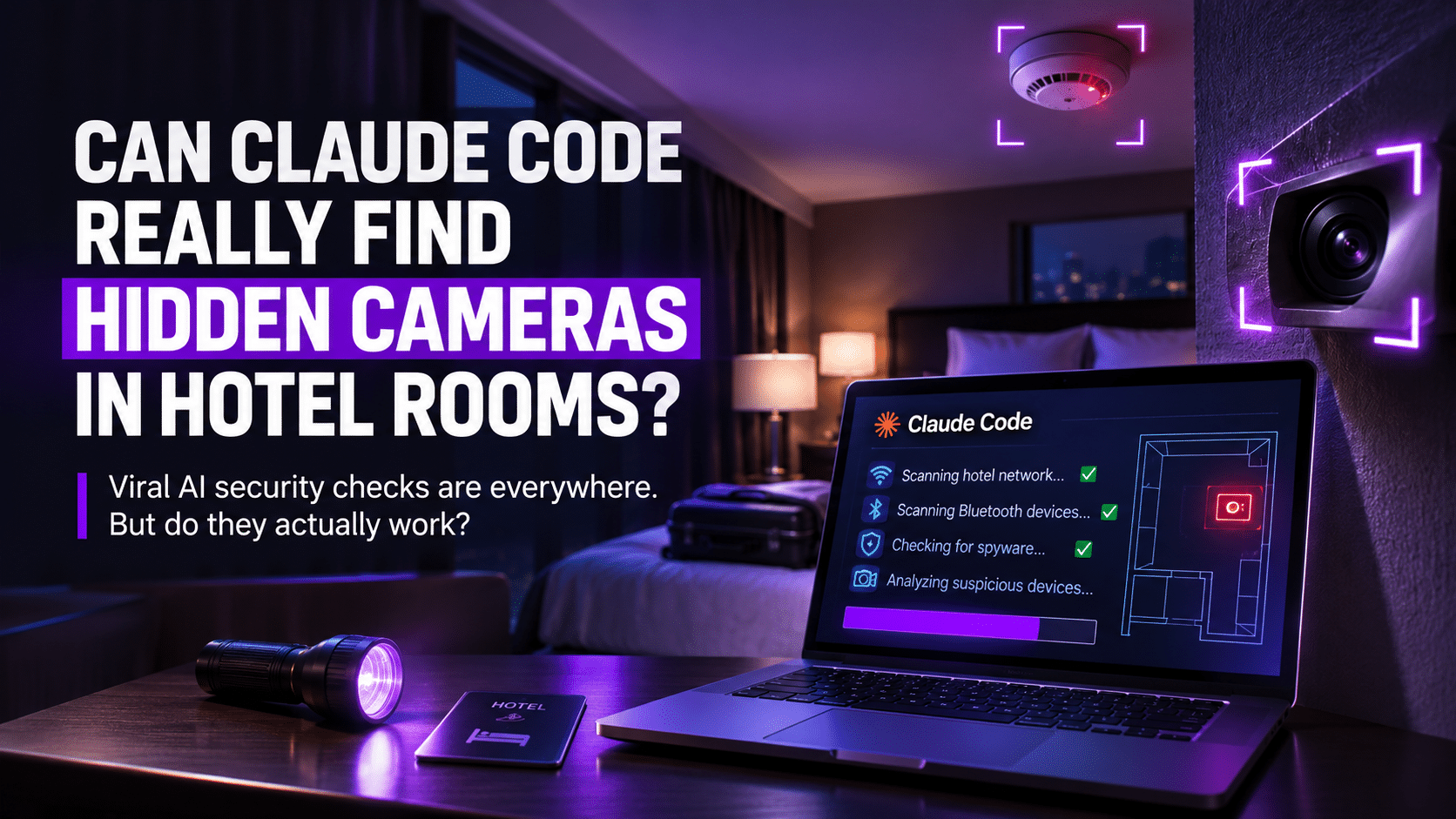
The posts describe Claude Code as a read-only check-in assistant. You run it from your laptop before you unpack, and it works through five stages:
- Wi-Fi scan. It lists every device on the hotel network using tools like Nmap, works out the maker from each device’s MAC address, and flags open ports that cameras often use for video streaming.
- Bluetooth scan. A short script listens for trackers such as AirTags, Tile and Samsung SmartTags. According to coverage of the prompt, it listens in short bursts over about ten minutes and matches trackers by their signal pattern, because trackers keep changing their addresses.
- Phone check. Amnesty International’s Mobile Verification Toolkit looks for signs of spyware on your own phone.
- Physical inspection. If the hotel isolates guests on the network, the AI walks you through a flashlight check of mirrors, vents and anything pointing at the bed.
- Report. Suspicious findings go into a ranked list with next steps, from asking for another room to calling the police.
One detail we liked: the prompt tells the AI never to log in to anything, never open a video stream and never touch devices that aren’t yours. That’s the right instinct for any check like this.
A second thread, from a different account, went further and claimed Claude Code reverse-engineered a hotel door lock in 90 seconds. We’ll get to that one below.
Can AI really detect hidden cameras in hotel rooms? What experts say
The experts Cybernews spoke to agree the techniques are real and old. Samuel Hassine of Filigran said a network scan, a Bluetooth listen and Amnesty’s phone toolkit are all legitimate, and that the AI mostly glues them together and explains the output in plain English, which he called genuinely useful. Raghu Nandakumara of Illumio made a similar point: take Claude Code out and you’re left with a scan, a listener, a spyware check and a torch. Brian Higgins of Comparitech wondered whether anyone careful enough to run these checks needs the AI layer at all.
Our take: that’s fair, but gluing it together is the whole value for a normal traveler. Nobody wants to read 500 lines of scan output at midnight in a strange room. The AI works as an interpreter, not as a detector.
Christiaan Beek of Rapid7 added a useful comparison. He ran an offline open model against his own home IoT network, and it flagged a badly built device within about 20 minutes. But that device sat on a reachable network. A hidden camera in a hotel room is built to avoid exactly that.
Why a clean scan doesn’t mean the room is clear
There are three reasons, and all of them are boring and important.
- SD card cameras. Many cheap spy cameras record to a memory card and never touch the Wi-Fi.
- Their own connection. Some use a built-in mobile connection, so there’s nothing on the hotel network to see.
- Guest isolation. Plenty of hotel networks stop guests from seeing each other’s devices, so a scan can show almost nothing even if something is connected.
Beek’s line sums it up: no model can analyze a signal it never receives. Treat any scan as one small clue, not a verdict. Finding hidden cameras in hotel rooms is still mostly a physical job.
What about the “door lock hack in 90 seconds”?
The claim was that Claude Code reverse-engineered a hotel lock, found 2014-era encryption and linked it to a smoke detector. Hassine told Cybernews nobody has actually demonstrated this. A Community Note on the thread also pointed out that the well-known Onity lock flaw needed a device plugged physically into the lock’s data port, not a wireless scan from the bed, and that Onity began shipping fixes back in 2012.
So we’d file that one under entertainment until someone shows a repeatable demo.
Follow the money: when the thread ends in a sales link
Cybernews reports the thread promoted ten free prompts, then pointed readers to an app advertised at $39.99 for the full package. Beek’s advice is simple: notice whether the story ends with a link to buy something.
The bigger risk, according to Sai Molige of Forescout, is people copying prompts, skills and repositories and running them with their own privileges. A “find hidden cameras” skill is a perfect lure, because you’d happily give it network and Bluetooth access. The tool meant to protect you could be malware or a trojanized copy.
Molige also flagged a legal catch. Many guest Wi-Fi agreements ban port scanning and similar checks, so you could break the hotel’s terms even with good intentions.
How likely are hidden cameras in hotel rooms, anyway?
It helps to keep some perspective. A Time explainer quotes the US hotel trade group saying it isn’t the practice of American hotels to put cameras in guest rooms, and a security-industry executive saying big chains wouldn’t take on that liability. The realistic worry is a rogue individual, since experts say small cameras can be tucked inside ordinary objects like clocks and lamps.
Short-term rentals add another layer. A security expert’s guide notes that hidden cameras in bedrooms, bathrooms and other private spaces are generally unlawful in the US, though rules differ by state. So hidden cameras in hotel rooms are rare, but rare isn’t never, and the checks are cheap.
How to check for hidden cameras in hotel rooms without AI
This is the part that actually works, and it takes about five minutes.
- Look at what faces the bed and the bathroom. Smoke detectors, clocks, chargers, TVs, vents, picture frames and mirrors are the usual hiding spots. Showerheads too.
- Do a torch sweep. Lights off, then move your phone torch slowly across suspicious objects. A lens can glint back at you.
- Inspect odd objects up close. One security expert in the guide above unplugged suspicious items and turned them over, looking for things like a stray QR code.
- Use your phone’s tracker alerts. For AirTag-style trackers, Hassine said built-in phone alerts do the job better than a homemade scan.
- If you find something, don’t rip it out. Experts suggest unplugging the device or covering the lens, and not removing it, because a host could accuse you of damaging their property. Take photos, then report it to the hotel or platform and the police.
If you still want to run a scan
We’re not telling you not to. Just keep some ground rules:
- Only scan with your own devices, and keep it passive and read-only.
- Read the hotel Wi-Fi terms first.
- Don’t download random prompts, skills or apps that promise camera detection. Stick to well-known tools from their official sources.
- Remember a clean result only means nothing showed up on that network.
Hidden cameras in hotel rooms FAQ
Can Claude Code detect hidden cameras in hotel rooms?
It can run or guide network and Bluetooth scans that might reveal cameras connected to the same Wi-Fi, and it explains the results clearly. It can’t see cameras that record to SD cards or use their own mobile connection, so it can’t guarantee a room is clear.
Do AI hidden camera detection prompts actually work?
The tools behind them (Nmap, a Bluetooth listener, Amnesty’s toolkit) are real. The AI mainly connects the steps and translates the output. Experts say the results are limited, especially in hotels that isolate guest devices.
Can Claude Code hack a hotel door lock?
No one has shown a repeatable demo of the 90-second lock hack. The old Onity flaw people point to needed physical access to the lock, according to a Community Note on the thread.
Is it legal to scan hotel Wi-Fi?
It depends on the network’s terms. A Forescout expert warned that many guest Wi-Fi agreements prohibit port scanning. Check the terms first. This isn’t legal advice.
What’s the best way to find hidden cameras in hotel rooms?
A careful physical inspection: mirrors, vents, smoke detectors, chargers, TVs and anything facing the bed, plus a torch sweep for lens glints. Use a scan as an extra clue, not the main method.
What should I do if I find a hidden camera?
Unplug it or cover the lens, but leave it in place. Photograph it, then report it to the hotel or rental platform and to the police.
Final thoughts
The viral story is half true, which is why it spreads. The scanning tools are real, and having an AI explain the output is genuinely handy. But a clean scan doesn’t clear a room, a 90-second lock hack hasn’t been shown, and threads that end in a sales link deserve extra suspicion. For hidden cameras in hotel rooms, your eyes and a torch still beat any prompt.
We break down viral security claims in plain English at iShowCybersecurity and on Instagram at @ishowcybersecurity.
Sources
- Cybernews: Can Claude Code really detect hidden cameras in hotel rooms?
- Time: Are hotels spying on you?
- Yahoo News: How to find hidden cameras in an Airbnb, according to a security expert
- Amnesty International Mobile Verification Toolkit (MVT)
- Nmap
Based on public reporting as of November 6, 2026. Always follow local laws and the terms of any network you use.